
Drywall Hole Repair & Wall Patching: A Clear Step‑by‑Step Guide
Drywall is designed to be repaired.
Small dents, popped screws, and big holes in drywall are almost guaranteed in any home: door handles punch through, kids roughhouse, furniture hits walls. The good news is that drywall is designed to be repaired. With the right approach, you can patch anything from tiny nail holes to a basketball‑sized opening and get the wall ready for paint.
This guide walks you through drywall repairs in order of difficulty – starting with simple nail pops and working up to full cut‑out patches – so you know what tools you need and what to expect at each step.
Skip to a section:
- Overview & Safety
- Drywall & Drywall Mud Basics
- Tools & Materials by Hole Size
- Repairing Small Holes, Nail Pops & Dents
- Repairing Medium‑Sized Holes (Mesh Patch)
- Repairing Large Holes with a Drywall Patch
- Feathering, Sanding & Getting a Smooth Finish
- Preventing Future Drywall Damage
- Drywall Repair FAQ
- Not Comfortable Doing This Yourself?
Overview & Safety
This guide focuses on interior drywall (a.k.a. sheetrock, gypsum board or plasterboard) on walls and ceilings. The techniques here apply to most modern homes where drywall is installed over wood or metal studs.
Safety notes:
- Use a dust mask and eye protection when sanding or cutting drywall.
- Be careful when cutting large holes – plumbing pipes and electrical wires may be behind the wall.
- Use a stud finder or start with a small exploratory cut if you’re unsure what’s in the cavity.
- Lay down drop cloths; drywall dust is very fine and can travel.
Drywall & Drywall Mud Basics
Drywall is simply a core of gypsum sandwiched between layers of heavy paper. The paper gives it strength; without it, the gypsum would crumble. The goal of any repair is to restore a smooth, continuous surface so the wall looks like one piece again.
When people say “drywall mud,” they’re usually referring to joint compound or spackling. There are a lot of options on the shelf, but here’s a simplified way to think about them:
- Spackling: Great for small holes, nail pops, and little dents. Easy to sand.
- All‑purpose / Plus‑3: Good all‑around joint compound for most wall repairs.
- Topping compound: Used for final coats or for creating texture.
- Hot mud (setting compound): Powder you mix with water that hardens in a set time (20/45/90 minutes). Good when you need strength or quick turnaround.
If you’re overwhelmed by choices, it’s hard to go wrong with an all‑purpose or Plus‑3 joint compound and a small tub of spackling for tiny repairs.
Tools & Materials by Hole Size
For Small Holes, Nail Pops, Dings & Dents
- 2″–3″ spackling knife (with metal end if possible)
- Spackling paste or lightweight joint compound
- 220‑grit sanding sponge
- Drywall screws and screwdriver/drill (for loose drywall or nail pops)
For Medium‑Sized Holes (you can’t see into the cavity)
- 6″ taping knife (again, metal‑ended is handy)
- All‑purpose joint compound
- Self‑adhesive mesh tape
- 120‑ and/or 220‑grit sanding sponge
For Larger Holes (you can see inside the wall)
- Utility knife
- Drywall jab saw
- 6″ and 10″–12″ taping knives
- Drywall mud pan
- Extra piece of drywall (same thickness as existing)
- Backing material (1×2 wood strips or similar)
- Drywall screws + drill or screwdriver
- Mesh tape
- All‑purpose joint compound
Repairing Small Holes, Nail Pops & Dents
Small holes and nail pops are the easiest to fix and a good place to build confidence. The basic steps are the same whether it’s a picture‑hook hole, a popped screw, or a small dent.
1. Re‑secure loose drywall (for nail pops)
- Drive the existing screw in about a quarter turn to tighten the drywall to the stud.
- Add one or two new drywall screws a couple of inches above and below the pop to hold the panel firmly.
2. Create a small divot
Use the back of your spackling knife to press gently on the spot and create a shallow hollow. This pushes any raised paper or debris inward so your patch sits flat.
3. Apply spackling (“peanut butter on bread”)
- Load a little spackle on the knife and press it into the hole.
- Spread it out smoothly, like spreading peanut butter on bread – not too thick, not too thin.
- Leave a thin layer slightly proud of the surface; it will shrink as it dries.
4. Sand, inspect, and repeat if needed
- After the patch is fully dry, sand with a 220‑grit sanding sponge until it’s flush with the wall.
- Close your eyes and run your hand over it – if you feel a ridge or dimple, add another thin coat and sand again.
Repairing Medium‑Sized Holes (Mesh Patch)
For holes bigger than a coin but smaller than a full cut‑out (you can’t see into the wall), self‑adhesive mesh tape reinforces the area so the mud doesn’t crack.
1. Cover the hole with mesh tape
- Apply mesh tape over the damaged area, overlapping slightly in each direction.
- Press it firmly so it sticks to the wall and lies flat.
- Use your knife to press, cut, and trim excess tape as needed.
2. Apply the first coat of joint compound
- Load a 6″ taping knife with joint compound.
- Press mud through the mesh into the hole, then spread it out in a thin, even layer.
- Don’t worry if the first coat looks rough – thin is more important than perfect at this stage.
3. Build up thin coats
- Let the first coat dry completely.
- Lightly sand to knock down ridges.
- Add another thin coat, extending a little farther each time to blend into the surrounding wall.
- Repeat as needed. Several thin, “smooth peanut butter” coats are much better than one thick, lumpy coat.
Repairing Large Holes with a Drywall Patch
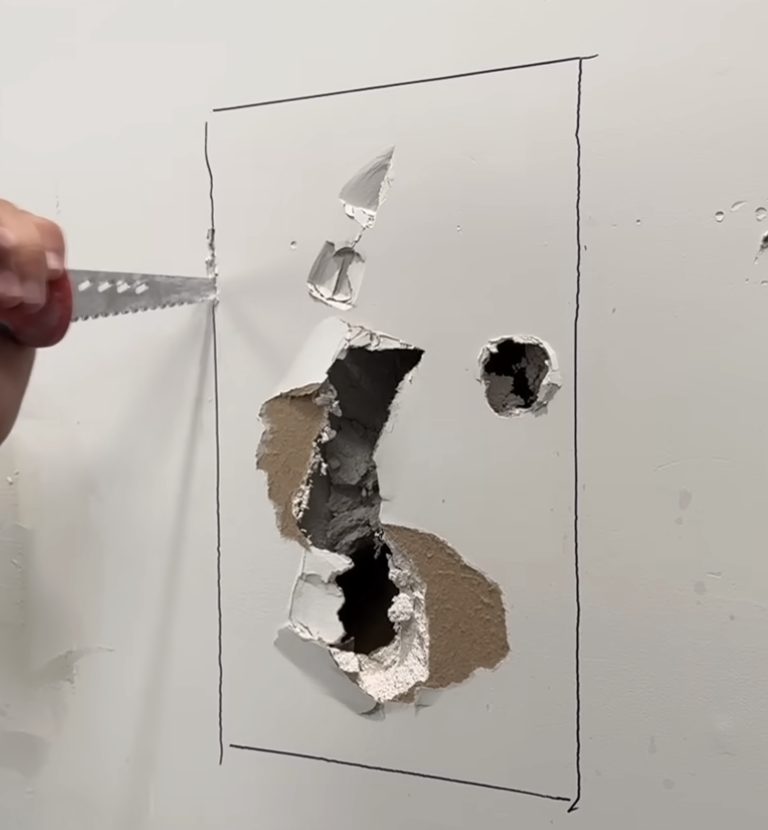
For larger damage where you can see open cavity, studs, or pipes, you’ll cut out a clean rectangle and insert a new piece of drywall supported by backing. Take your time here; careful prep makes finishing much easier.
1. Cut a patch piece
- Cut a piece of new drywall slightly larger than the damaged area.
- Score the front paper with a utility knife, snap it over your knee, then cut the back paper to separate.
- Hold the patch over the hole and trace around it with a pencil or marker.
2. Cut out the damaged area
- Use a jab saw or utility knife to cut along your traced outline.
- Work slowly and be cautious – if you feel resistance or something hard behind the wall, stop and investigate (it could be a pipe or wire).
- Remove the broken drywall and clean up rough edges with a knife.
3. Install backing
- Cut 1×2 wood strips a few inches longer than the opening width.
- Slide a piece behind the existing drywall so it bridges the hole, then screw through the face of the drywall into the backing at the top and bottom.
- Repeat with another piece if needed. This gives your patch something solid to screw into.
- Alternatively, if your hole lands neatly over a stud, you can screw the patch directly to the stud edges.
4. Secure the patch
- Place your drywall patch into the opening; it should sit flush with the surrounding wall.
- Screw through the patch into the backing and/or stud, keeping screw heads just below the surface of the paper.
- Scrape any raised edges with a knife so everything is flat.
5. Tape and mud the seams
- Apply mesh tape directly over the seams where old drywall meets new.
- Load your taping knife with mud and push it firmly into the tape and joints.
- Cover the patch with a thin, even coat, extending several inches beyond the seams.
- For larger patches, switch to a 10″–12″ knife and use a mud pan to make spreading easier.
Feathering, Sanding & Getting a Smooth Finish
The difference between a patch you always see and one that disappears is in the feathering and sanding.
Feathering the edges
- Use a wider knife for later coats (10″–12″).
- When you pull the knife across the patch, press harder near the center and lighter at the outer edge.
- This creates a slightly thicker build over the repair and a thinner edge that blends into the original wall.
- Think of it as creating a very shallow, wide ramp instead of a lump.
Sanding between coats
- Let each coat dry fully – rushing this step leads to gumminess and torn paper.
- Use a sanding sponge (120‑grit for shaping, 220‑grit for finishing).
- Sand just enough to knock down ridges and high spots; don’t over‑sand back to the tape.
- After the final coat, sand until you can’t feel where the patch begins, even with your eyes closed.
Texture & paint
Once the wall is smooth:
- Prime the patched area to seal the mud and avoid flashing through the paint.
- If your walls have texture (orange peel, knockdown, etc.), apply a matching texture product before the final paint.
- Finish with the same paint and sheen as the rest of the wall.
Preventing Future Drywall Damage
A few small upgrades can prevent you from having to repeat the same repairs:
- Install door stops so handles don’t slam into walls.
- Use wall‑mounted bumpers behind commonly used doors or bed frames.
- When hanging heavy items, anchor into studs or use appropriate wall anchors.
- Teach kids which walls are off‑limits for rough play (easier said than done, but it helps!).
Drywall Repair FAQ
How do I know when a hole is too big for just spackling?
As a rough rule, if the hole is bigger than a quarter and the wall feels weak or flexible around it, it’s better to use mesh tape or a cut‑out patch. Spackling alone on a larger, unsupported hole tends to crack later.
How many coats of mud do I really need?
For medium and large repairs, plan on at least two to three thin coats, sometimes more. It’s better to think in terms of “as many coats as it takes to be smooth” rather than aiming for one heavy pass.
What grit sandpaper should I use?
120‑grit is good for knocking down high spots or shaping early coats. 220‑grit is ideal for final smoothing before priming. A sanding sponge is easier to control than loose sandpaper and helps you avoid gouging the patch.
Can I use hot mud (setting compound) instead of pre‑mixed joint compound?
Yes. Hot mud is great when you want a faster set time or a tougher first coat. Just remember it sets by chemical reaction, not drying, so only mix what you can use in that time window (20/45/90 minutes depending on the product).
Not Comfortable Doing This Yourself?
Patching small nail holes is very DIY‑friendly, but larger repairs – especially around plumbing, electrical, or textured ceilings – can feel intimidating. If you’d rather have a professional handle the mess and leave you with paint‑ready walls, that’s completely reasonable.
On this site you can:
- Use the “Request Service” option in the main menu to ask for drywall repair help, or
- Email a description and a photo of the damage to: your-email@example.com (replace with your actual contact).
Include how big the hole is, whether it’s on a wall or ceiling, and any details about pipes or wires nearby so a specialist can give you an accurate response.
Disclaimer: This article is for general information only and may not cover every situation or local building code. Always take appropriate safety precautions and consult a professional if you are unsure about cutting into walls, working near utilities, or finishing large areas.
